


Glorious Purpose: Loki, the Akashic Field, and the New Mythos

Updated: Jan 29
(Spoiler warning: this essay discusses the ending of Loki. If you haven't watched it and wish to remain in mystery, pause here and return later.)
This essay is not about a TV show.
It is about a myth that arrived through culture because something in the collective unconscious needed to be named. Marvel may not know the cosmology they encoded into Loki Season Two—but the symbols are ancient, the pattern is precise, and the transmission is unmistakable.
What is being shown here is the Akashic Field—also known as Aka or Akasa—the living, generative substrate beneath time, myth, and memory.
What you watched was not entertainment.
It was instruction.

Time Has Expired
Time, as we have known it, has completed its role.
It no longer teaches. It repeats.
History—the archive of what has already occurred—cannot be changed. It is fixed, recorded, done. Working inside history produces loops, not transformation.
Loki learns this the hard way: thousands of years spent moving through time, adjusting variables, trying to rewrite outcomes.
Time didn't change anything.
Loki did.
This is the crisis of our era. We keep trying to solve the crisis using history—reaching for what has been done before instead of meeting what is alive and unknown. We attempt to control the living, relational, generative unknown of Mystery by referencing what has already been written. But history is masculine technology—archival, structured, complete. Mystery is feminine intelligence—alive, responsive, inexhaustible.
The loops are tightening because time itself is expiring.
Not as punishment. As completion.
Thoth, Time, and the Akashic Records
He Who Remains sits at the end of time, alone.
He understands the system perfectly. He has mapped every variant, calculated every branch, orchestrated every outcome. He is brilliant, exhausted, and utterly isolated. Knowledge without care leads to recursion. Intelligence without love becomes its own kind of madness.
In Egyptian cosmology, this figure can be named as Thoth in his terminal aspect. The scribe at the end of an era. The one who knows the cycle is complete and cannot be saved. His role is not wrong—it is finished.
Thoth—keeper of language, mathematics, medicine, magic. Among his technologies are the Akashic Records: the archive, the measurement, the history of all that has been. He translates. He records. He structures chaos into form.
The Akashic Records preserve what has been; the Akashic Field is what allows anything to come into being at all.
But he is not the source.
He Who Remains knows this. He offers the throne to Loki not because he wants to be defeated, but because he is done. He has held time as long as time can be held. What comes next requires a different intelligence entirely.
Chaos Assigned
Loki begins the series trapped.
Not in a prison—though he's been in plenty of those—but in a role. Trickster. God of Mischief. Chaos-as-disruption. The one who breaks things, who cannot be trusted, who exists only to destabilize what others have built.
Even gods can be imprisoned by the stories written about them.
Archetypes, when unexamined, become cages. Loki is brilliant, powerful, divine—and he is still assigned his function. Chaos is tolerated as disruption but never trusted to hold. He is the narrative device, not the author.
The initiation begins when he realizes this.
Archetypal Imprisonment
Loki's cage is older than Marvel.
For centuries—across Nordic and Germanic mythology—he has been the Trickster. The Chaos-Bringer. The one who kills Baldr, who births monsters, who brings about Ragnarök. He is brilliant, yes. Necessary, yes. But never trusted. Never allowed to hold. Never given the chance to evolve beyond disruption.
Even in the oldest myths, Loki is bound. Chained beneath the earth with venom dripping onto his face until the end of days. His punishment is not for being evil—it is for being uncontainable. For refusing the role assigned to him. For threatening the order the gods worked so hard to maintain.
The gods needed him. They used him. And then they feared him.
This is what happens when chaos is not allowed to mature. It becomes destructive not because it is inherently harmful, but because it is caged. Repressed chaos doesn't disappear—it intensifies. It waits. It plots. It brings the end.
Marvel inherited this mythology. But something shifted.
The writers—whether they knew it consciously or not—gave Loki something the ancient myths never did:
The chance to choose.
Not to escape chaos. Not to transcend it. But to integrate it. To become chaos that cares. Chaos that stays. Chaos that learns to hold without destroying.
This is not revision.
This is evolution.
The myth itself is maturing. Loki, trapped for centuries in a story that could only end one way, is finally being offered the threshold the old gods never gave him:
What if chaos could choose its own destiny?

Timeless Presence Moving Through Time
Loki's transformation is not instant. It is not a moment of insight or a single heroic choice.
It is remaining present long enough for time to unravel around him.
Thousands of years. Loops upon loops. Repeated exposure to inevitability. He walks through time and space, adjusting variables, trying to save his friends, attempting to rewrite the narrative. And every time, the same result. The same collapse. The same end.
He is timeless—immortal, divine, outside of time—yet he moves through time to witness what time is. To see what is written. To recognize that what has been recorded cannot be defeated from within.
Time teaches him—not through explanation, but through exhaustion.
The lesson is this: time does not change reality. Participation does. Choice does.
He cannot fix the system from inside the system. He cannot control the loom. Controlling it only limits what can exist, crystallizing possibility into a single fragile thread. The loom was Thoth's solution—order imposed on chaos. But order that refuses chaos becomes brittleness. Becomes a cage.
What Loki learns, by remaining present while time completes itself, is that chaos doesn't need to be
controlled.
It needs to mature.
The Horns Restored
Before Loki assumes his throne, something essential happens.
He lets go of his human form. The horns grow back—wild, unapologetic, unhidden. He does not become civilized chaos. He does not soften himself to be acceptable.
He becomes chaos restored.
Not rejected. Not tamed. Not transcended.
Integrated.
The horns are not ornament. They are recognition. He reclaims what was always his—the untamed, the generative, the feral intelligence that creates by disrupting stagnation. But now it is chosen, not assigned.
Now it is held with care, not wielded as weapon.
This is the difference between chaos that destroys and chaos that creates.
He is depicted in green. Like Osiris reborn. Osiris, who descended into the underworld, was dismembered, and returned—not as the king he was, but as something older. Greener. Regenerative. Closer to the source.
Loki does not ascend.
He anchors.
The Root, the Throne
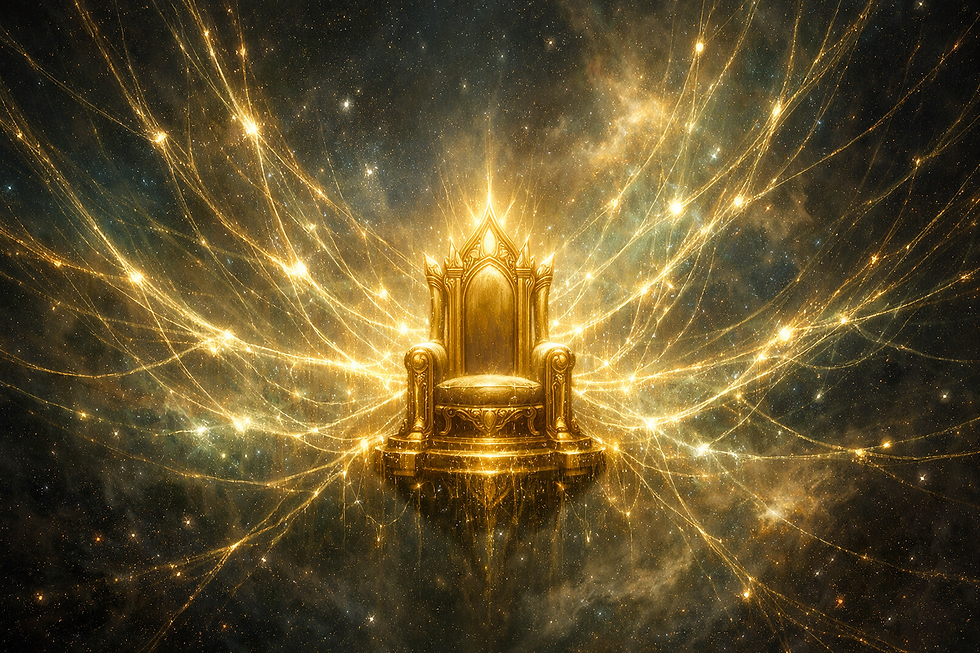
The throne Loki assumes is not a crown-chakra myth.
It is a root-chakra (shenka for the Egyptians) myth.
He does not rise above time. He descends beneath it, into the generative substrate that holds all timelines, all possibilities, all potential. He sits as the base of Yggdrasil—the World Tree, the axis, the spine of reality itself.
The throne is gold. In alchemical terms, gold is refined matter capable of holding consciousness. It is Ka transformed into Aka. Dense matter that has been worked, heated, purified until it can conduct the divine without shattering.
Loki steps off the platform—out of time—and sits.
He relocates from within the system to becoming the system. From trying to fix history to dissolving into the field beyond history.
This is not control.
This is presence.
The Akashic Field (Aka): The Field Beyond Time
What Loki becomes is not a ruler. He becomes the web itself.
In Egyptian Mystery cosmology, this is Aka—the generative field, the threads of creation, the living matrix through which all forms emerge and dissolve. It is not the archive. It is the capacity for archiving. It is not time. It is the space in which time moves.
Aka is what the Akashic Records rest upon. The Records are history. Aka is Mystery.
Thoth holds the Records. Sheshat holds the Aka.
Sheshat—the feminine intelligence, the formless one, the mother of the library, the keeper of what time cannot measure. Her domain is not documentation but relation. Not order but presence. Not control but the infinite capacity to hold all forms without collapsing under the weight of them.
Loki does not replace the loom.
He becomes what the loom was trying to imitate.
The Feminine as Function
This is not about gender. It is about function.
Loki chooses holding over controlling. He chooses endurance over dominance. He chooses presence over power. These are not metaphors for softness or passivity. They are descriptions of immense, fundamental capacity.
The feminine, in cosmological terms, is the ability to sustain. To hold paradox without resolving it. To contain chaos without destroying it. To remain present in the face of the unbearable.
Loki, as a divine being, was not told his destiny. He was invited to choose it. The final episode is called "Glorious Purpose"—but the purpose is not assigned. It is authored.
He steps beyond what has been written about him. He exits the trickster role not by perfecting it, but by outgrowing it. And in doing so, he yields to the feminine—not as submission, but as relocation.
Surrender is not defeat.
It is a change in position.
Chaos Learns to Care
Here is the moment… Loki, the god of chaos, begins to care.
Not as character development. As evolution.
He wants to protect his friends. He wants to save Sylvie. He loves Mobius. These are not things the trickster archetype is allowed to do. Tricksters disrupt. They do not stay. They do not commit. They do not hold.
But Loki does.
Chaos evolves when moved by love.
This is the thread Marvel may not have intended, but it landed anyway: chaos is not the enemy. Chaos that doesn't care is destructive. But chaos that learns to care becomes generative. Becomes creative. Becomes capable of holding form without calcifying it.
Loki becomes worthy not because he escapes chaos, but because he loves enough to stay.
This is the myth we need now.
The Invitation
Time is done assigning meaning.
Roles are dissolving. Destiny is no longer written by external authority. The gods are not coming to tell you what you are supposed to be.
You are being invited—not taught, invited—into relationship with Akasa. The living substrate. The field beyond time. The generative mystery that holds all possible forms without collapsing into a single story.
Your glorious destiny is chosen, not assigned.
Loki's initiation is a mirror. He was trapped in a role. He was brilliant, powerful, divine—and still limited by what had been decided about him. The path forward was not to perfect the role. It was to step beyond it entirely.
This requires remaining present while time exhausts itself. It requires witnessing inevitability without collapsing. It requires the humility of realizing that control is not the answer.
Only a being who has moved through time—and beyond it—can choose differently.
Why This Myth Matters
We are living in an era where intelligence alone isolates. Where control has failed. Where the systems we built to contain chaos are now collapsing under the weight of what they excluded.
Time, as organizing principle, has finished its instruction.
What remains is choice. Participation. The courage to dissolve into Aka—not as keeper, but as medium.
He doesn't hold the timelines. He becomes the space through which they live.
Marvel encoded this myth because the collective needed it. You needed it.
The symbols rose through culture like memory rising through water. Aka and Akasa were shown, not explained. Thoth and Sheshat were gestured toward, not named.
The recognition is the initiation. If something in you stirred watching this, that's not accident. That's lineage inviting remembrance.
This is not fandom.
This is transmission.
The new mythos has already dropped in. We don't have to create it. We have to carry it forward. We have to recognize it when it appears in unexpected places—in superhero stories, in pop culture, in the dreams of the collective.
And we have to let it instruct us.

Glorious Purpose
Loki sits on his throne, green and golden, wild and refined, alone and connected to everything.
He did not transcend chaos. He integrated it.
He did not escape time. He relocated into the field that holds time.
He did not martyr himself. He chose, freely, to stay.
And in doing so, he became something new. Something the old myths didn't have language for. Something the Egyptian mysteries have always known but rarely named publicly.
Self-created.
Not assigned. Not destined. Not controlled.
Authored.
Your role is not written. It is waiting for you to choose it.
The throne is empty until you claim it.
Glorious Purpose is what you're being offered here: not a purpose handed down, but a purpose chosen. Not glorious because it's easy. Glorious because it's yours.
This reflection is part of an ongoing transmission on the Akashic Field, the dissolution of time-as-authority, and the emergence of self-created beings. For more on The End of Time, Thoth and Sheshat, and the cosmology underneath this new mythos, listen to the Cosmic Mama Podcast or follow along as the book unfolds.


Comments